
Plan With Purpose: Build the Financial Independence You Want and the Legacy That Lasts


More than 11,000 Americans reach age 65 every day according to Social Security Administration,1 continuing the “Silver Tsunami.” Amid this shift, financial planning has never felt more urgent or more complex. The number one question for those approaching retirement remains the same: “Will I have enough?” Going into retirement without a financial plan is like traveling to an unfamiliar destination without navigation.
Rather than focusing on retirement as an endpoint, plan for your Financial Independence Day: the moment you work because you want to, not because you must. Reaching that point requires intentional planning for how and when your assets can support your lifestyle. For some people, especially business owners whose wealth may be tied up in their companies, this means planning ahead to unlock the value of those assets over time.
Start With What You Want Your Life to Look Like
Start by defining what you want for your lifestyle, your family, your future, and potentially your legacy. Once you articulate this vision, quantify and prioritize your goals. Traditionally, retirement income has been viewed as a three-legged stool made up of Social Security, pensions or qualified retirement plans, and personal investments. To start, subtract your projected after-tax Social Security and pension income from your desired annual spending. The remaining amount will likely come from withdrawals or retirement accounts. Invest thoughtfully; a portfolio that is too conservative may lose purchasing power to inflation. Don’t just rely on rules of thumb such as a static 4% withdrawal rate. Your financial life is dynamic, and effective planning should be flexible enough to adapt to changing circumstances.
Strategies for Shortfall and Surplus Planning
Shortfall and surplus planning require very different approaches. If you face a shortfall, you may need to consider options such as:
- Delaying retirement
- Reducing lifestyle spending
- Increasing savings
- Adjust your asset allocation
- Implementing tax‑efficient income strategies
Starting early maximizes the time value of money, giving your assets more room to grow.
Taxes can also significantly erode retirement income. If most of your assets sit in tax‑deferred accounts, you have limited control over taxable income in retirement because distributions are taxed as ordinary income. This can cause a larger portion of Social Security benefits to become taxable as well. Strategic tax planning is essential to managing this risk, given how frequently tax laws change under different administrations and philosophies.
Surplus planning, on the other hand, is an entirely different conversation. If reducing your investment risk still allows you to meet your goals, taking a more conservative approach may become a logical path forward.
A sound plan should also be stress‑tested to understand how it would perform under various scenarios, including:
- Market volatility
- Prolonged downturns
- Increased taxes
- Unexpected longevity
- A long‑term care (LTC) event
According to AARP, long‑term care costs can total hundreds of thousands of dollars over a lifetime, making it a major planning consideration.
Align Your Wealth with Your Purpose
Before developing a legacy plan, it’s essential to address your retirement income, tax exposure, healthcare, and LTC considerations should be addressed. Legacy planning is deeply personal and should align with your values and your purpose. Key questions to consider include:
- How can I minimize taxes at death?
- How do I ensure that more of my wealth goes to my heirs or charities?
Effective legacy strategies often require coordinated work among legal, tax, and financial professionals. Attorneys can help establish wills, trusts, powers of attorney, and healthcare directives as part of the estate planning process. Financial advisors ensure proper asset titling and beneficiary designations. Recent changes under the SECURE Act have made thoughtful IRA planning even more important, particularly for beneficiaries who must now navigate compressed distribution timelines.
Understanding Filial Responsibility and Its Impact
A growing challenge for many families is the cost of caring for aging parents. In several states, filial responsibility laws may require adult children to pay for a parent’s long‑term care if the parent cannot. This obligation can dramatically affect retirement readiness or your own legacy planning. Families should address these issues proactively with open conversations and acknowledge the emotional dynamics that often accompany them.
Your financial life is a journey—and thoughtful planning ensures you move toward the lifestyle you want and the legacy you hope to leave. By clarifying your goals, preparing for risks, and coordinating with the right professionals, you can build a strategy that adapts as life changes. At Bryn Mawr Trust, we partner with you at every step, helping you make informed decisions so you can retire with confidence and pass on your values as well as your wealth.
Begin your journey
Have questions?
Speak with an financial expert.
Recent Articles
-

Two the Point – A Good Economy Isn’t Enough
A strong economy doesn’t guarantee strong investment opportunities. Watch for key insights on navigating today’s market.
-

Tax Planning Moves to Consider Before Year-End
Tax planning starts long before filing season. Discover key year-end tax strategies, retirement contribution opportunities, charitable giving tips, and other…
-
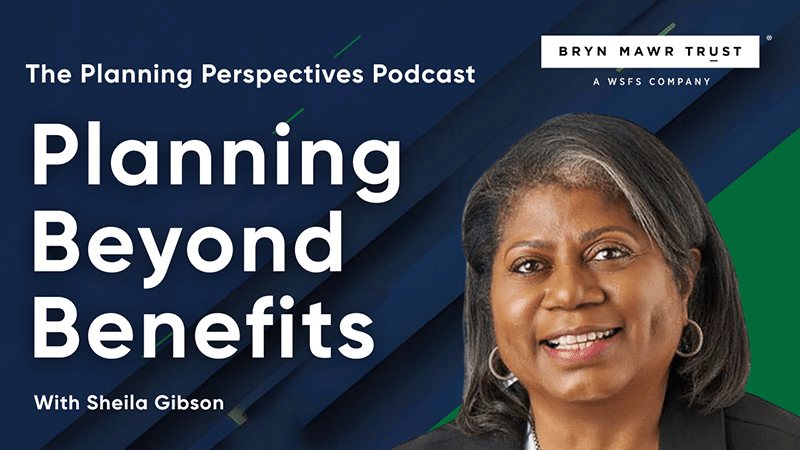
Planning Beyond Benefits (Ep. 28)
In this episode, Kate Duffy sits down with Sheila Gibson, Senior Wealth Advisor at Bryn Mawr Trust, to discuss the…
Recent Insights
-

Tax Planning Moves to Consider Before Year-End
Tax planning starts long before filing season. Discover key year-end tax strategies, retirement contribution opportunities, charitable giving tips, and other financial moves before December 31.
-
Planning Beyond Benefits (Ep. 28)
In this episode, Kate Duffy sits down with Sheila Gibson, Senior Wealth Advisor at Bryn Mawr Trust, to discuss the role of special needs trusts and guardianships in…