Tax Planning Moves to Consider Before Year-End
Tax planning starts long before filing season. Discover key year-end tax strategies, retirement contribution opportunities, charitable giving tips, and other financial moves before December 31.


Tax planning starts long before filing season. Discover key year-end tax strategies, retirement contribution opportunities, charitable giving tips, and other financial moves before December 31.

In business and life, summer presents an opportunity to review your goals and ensure that you remain on track. As part of a regular discipline, it will help protect against unexpected surprises at year end, when time and flexibility are limited. A meaningful mid-year review goes beyond comparing results to a budget. It should answer three…

Mid-year relocations create complex tax challenges for high-income families. Learn from Bryn Mawr Trust on how to manage equity compensation, establish domicile, and avoid multi-state tax exposure.

Discover how to give strategically by aligning your philanthropy with your key values, setting a budget, and focusing your impact where it matters most.

The cost of education continues to outpace general inflation, and with student debt still lingering in the news cycle, families today are taking a closer view of the cost of college.

The Traditional Approach: Deferring Taxes Over the last 50 years, investors have become very familiar with the adage “Defer, defer, defer!” when it comes to tax planning. The most accessible deferral vehicles have long included employer-sponsored 401(k) plans, traditional IRAs, and deferred compensation programs. By pushing income into the future, these tools allow high earners…

Wealth planning strategies are rarely about numbers alone, and traditional structures may not meet the complex long-term goals individuals seek to achieve. One planning concept that has gained increased attention in recent years is the purpose trust, designed to carry-out a defined objective rather than simply distributing assets to beneficiaries. Purpose trusts are not new, but their…
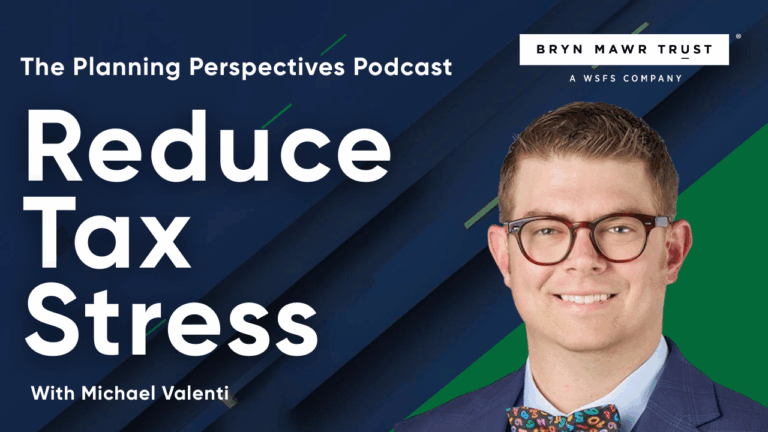
Why does tax time feel so overwhelming, and what can be done throughout the year to avoid those stressful moments in April? In this episode, Jamie Hopkins and Kate Duffy are joined by Michael W. Valenti, CPA, CFP®, CEPA®, MAcc, Tax Director at Bryn Mawr Trust Advisors, to break down why taxes feel emotional and…

For many professionals, bonus season is both rewarding and complex. While a year-end payout can represent a substantial portion of total compensation, it also presents an opportunity—and a challenge—for effective financial and tax planning. Thoughtful preparation can help ensure that your bonus works harder for you, aligning short-term windfalls with long-term wealth strategies. Bonuses are…

One of the basic tenets of the U.S. Internal Revenue Code is that everything has a cost, even if it’s not immediate. With few exceptions, all income gets taxed at some point. “At some point” is key. Taxpayers have some flexibility in recognizing income and paying tax on it. For example, if you own a…

Retirement is a goal we set with dreams of traveling abroad, playing golf, relaxing on the beach, pursuing a passion project, spending more time with family and friends, or ticking off items on our personal bucket list. As retirement comes into view, the most common question is. “Will you be financially secure when you take…

As you accumulate wealth over a lifetime, complexity follows. Early in your career, financial planning may have consisted of budgeting, cash flow, building an emergency fund, and getting proper insurance in place. You may even engage an advisor for investing, an attorney to draft wills, or a Certified Public Accountant (CPA) to do your taxes….

Staying current on the evolving tax landscape is crucial for effective financial planning. Download our Annual Tax Planning Guide and Year-End Planning Checklist to help keep you informed and on track about current tax and legal regulations.

Estate planning is one of the most thoughtful decisions property owners can make when placing real estate assets in a Limited Liability Company (LLC). Many people think estate planning is just about writing a will, but it involves much more—especially if you own valuable property. Using an LLC for real estate can provide legal protection,…

Financial planning can have many definitions. It can relate to your business, your finances, or your family in general. This exercise provides a road map of where you have been financially, where you are, and where you want to go. I am often asked how frequently I should partake in this exercise, and my answer…

Watch the replay of our exclusive webinar designed to equip you with the knowledge and strategies needed to successfully navigate tax season.

Now is the time to prepare for the potential volatility ahead in 2025 tax planning. With massive tax increases scheduled for year-end, this may be the most consequential year for tax legislation since the 2017 Tax Cuts and Jobs Act (TCJA). As the TCJA sunsets, increases to marginal tax brackets, decreases to gift and estate…

As 2025 approaches, policy shifts under a new Trump administration are taking shape. For investors, understanding the new tax, healthcare, and retirement landscape is crucial to navigating the future. Here are some of the most impactful potential policy changes and how they may influence your financial planning. Tax Reform One primary goal is the continuation…

As the year draws to a close, it’s the perfect time to review effective tax strategies. Watch our insightful webinar where we’ll uncover powerful tax-saving methods that can help you maximize your savings before the end of the year. Whether you are an individual or a business owner, you’ll learn actionable tips to reduce your…

As the year draws to a close, retirees need to remember to take their Required Minimum Distributions (RMDs) from retirement accounts. The Internal Revenue Service (IRS) mandates this annual withdrawal for individuals who have reached a certain age, and failing to take it can result in significant penalties. Required Minimum Distributions are the minimum amounts…

As we fast approach the end of 2024, tax planning becomes critical. One strategy that doesn’t always get the attention it deserves is tax loss harvesting. While the term might sound technical, the concept is simple, and when applied correctly, it can yield significant benefits. Let’s break down tax loss harvesting, why it matters, and…

Heading into the end of the year, as you contemplate the ramifications of the recent presidential election, prepare your Thanksgiving celebration, and compose your holiday gift lists, it’s a good time to assess your financial foundation. Here are five essential investment moves to consider before the new year. 1. Review and Adjust Your Risk Exposure…

For many of us, the end of the year is often a mad dash for charitable giving. Before you write that check this December, take time to reflect on how you will gift, the timing, and who will gift alongside you to make your donation most meaningful. There are many ways to give, including the…

It may be hard to believe, but December 31 will be here soon. Now is a great time to review your finances and implement smart tax planning to reduce your tax bill potentially. Here are seven essential strategies to consider. 1. Tax-Loss Harvesting Tax-loss harvesting involves selling investments that have lost value to offset capital…

Staying current on the evolving tax landscape is crucial for effective financial planning. Download our Annual Tax Planning Guide and Year-End Planning Checklist to help keep you informed and on track about current tax and legal regulations.

When the foundation of a structure becomes unstable, everything built on top must adjust or risk collapse. This principle is not only true in construction but also in financial and estate planning. In the United States, financial and estate planning is deeply intertwined with legal and tax codes, which form the foundation for achieving our financial…

The Tax Cuts and Jobs Act of 2017 (“TCJA”) brought numerous changes to the tax code including reduced individual income tax rates, significant increases to the standard deduction, and doubling of the estate tax exemption. The legislation also has a sunset provision, meaning many of the changes are set to expire at the end of 2025.

Four commonly missed topics you should make sure you disclose to your tax preparer that may help reduce the risk of costly return errors.
© 2026 Bryn Mawr Trust


© 2026 WSFS Bank. Member FDIC. Wilmington Savings Fund Society, FSB d/b/a WSFS Bank. Private Banking is a division of WSFS Bank. WSFS Institutional Services is a division of WSFS Bank.
Wilmington Savings Fund Society, FSB d/b/a/ Bryn Mawr Trust. Bryn Mawr Trust is a division of WSFS Bank. The Bryn Mawr Trust Company of Delaware is a subsidiary of WSFS Financial Corporation. Products and services are provided through WSFS Financial Corporation’s subsidiaries and their affiliates. Trust and investment advisory services are offered through Bryn Mawr Trust. Bryn Mawr Trust is not a registered investment advisor. Investment advisory services are also offered through Bryn Mawr Trust Advisors, LLC (“BMTA”), an SEC registered investment advisor and a subsidiary of WSFS Financial Corporation. BMTA’s registration as an investment advisor does not imply a certain level of skill or training.
Bryn Mawr Trust does not provide legal, tax or accounting advice but those services may be provided by affiliates or subsidiaries of Bryn Mawr Trust.
It remains a client’s responsibility to advise Bryn Mawr Trust (BMT) and Bryn Mawr Trust Advisors (BMTA), in writing, if there are any changes in a client’s personal/financial situation or investment objectives for the purpose of BMT or BMTA reviewing, evaluating, and/or revising its previous recommendations and/or services, or if a client would like to impose, add, or modify any reasonable restrictions to BMT or BMTA services.
All opinions expressed by the Associate(s) on television, radio, internet, or any other medium are merely opinions. You should not treat any opinion expressed as an inducement to make a particular investment or follow a particular strategy. Opinions expressed are based upon information that the Associate(s) considered reliable at the time spoken, but there is no guarantee of completeness or accuracy, and it should not be relied upon as such. The opinions do not represent the opinions of WSFS Financial Corporation or its subsidiaries. The Associate(s) and the listed entities have no duty to update or correct any information that was provided. Past performance is not indicative of future results, and as such, neither the Associate(s) nor any of the above-listed entities guarantee any specific outcome, performance, or profit. Before acting on any information from the Associate(s), consider suitability for your personal financial situation and seek the advice of your own financial professional.
Any third-party trademarks, and products or services related thereto, mentioned are for discussion purposes only. Third-party trademarks mentioned are not commercially related to, or affiliated in any way with, Bryn Mawr Trust products or services. Third-party trademarks mentioned are also not endorsed by Bryn Mawr Trust in any way. Bryn Mawr Trust may have agreements in place with third-party trademark owners that would render this trademark disclaimer not relevant.
INVESTMENTS: NOT A DEPOSIT. NOT FDIC – INSURED. NOT INSURED BY ANY FEDERAL GOVERNMENT AGENCY. NOT GUARANTEED BY THE BANK. MAY GO DOWN IN VALUE.
